
How to Select the Best iGaming Payment Provider for Your Casino
Jan 27, 2026
Fluid
How to choose an iGaming payment provider in Malta: balance MGA compliance, multi-currency support, AI fraud tools, fast transactions and smooth player UX.
Your payment provider can make or break your casino's success, especially in Malta's regulated iGaming market. Here’s what you need to know:
Compliance is key. Providers must meet Malta Gaming Authority (MGA) standards, including AML/KYC, GDPR, and transparent reporting.
Support for multiple currencies and fast transactions is non-negotiable for global players.
AI tools improve fraud detection, optimise payment paths, and offer real-time insights for better decision-making.
Player experience matters. Localised payment methods, mobile-friendly interfaces, and minimal friction ensure satisfaction.
Track key metrics like transaction success rates, processing times, and chargeback ratios to refine your payment system.
Selecting the right provider involves balancing speed, security, compliance, and user experience. A well-chosen system doesn’t just process payments - it builds trust and keeps players coming back.
How iGaming Operators Should Choose the Right Payment Provider
Malta's iGaming Payment Environment
Malta's iGaming payment landscape revolves around precise currency handling and the growing role of AI in payment solutions. Providers in this sector must balance local regulations with the demands of an international audience.
Regulatory and Compliance Requirements
Operating within Malta's iGaming industry means adhering to strict guidelines set by the Malta Gaming Authority (MGA) and EU directives. Payment providers are required to showcase strong AML (Anti-Money Laundering) and KYC (Know Your Customer) processes, comply with GDPR for data protection, and ensure transparent transaction reporting. These measures are essential for maintaining financial integrity and safeguarding both player funds and personal data.
Currency and Transaction Considerations
With the euro (€) as Malta's official currency, operators must ensure all transactions follow clear European formatting standards. However, given the global nature of iGaming, supporting multiple currencies is a must. This ensures smooth transactions for players across different markets. Alongside this, advancements in technology are reshaping payment systems, offering faster and more reliable solutions.
Fintech and AI Payment Solutions
AI-powered payment systems are transforming the iGaming sector by making transactions faster, more secure, and tailored to individual user preferences. By integrating AI, operators can simplify processes, improve fraud detection, and cater to the diverse needs of their player base. These technologies not only enhance efficiency but also create a more seamless experience for users.
Planning Your Payment Strategy
In Malta's regulated payment environment, having a well-thought-out payment strategy isn't just a bonus - it's a necessity. A clear plan not only boosts efficiency but also enhances the overall player experience.
A solid payment strategy aligns your payment systems with your business goals while prioritising player preferences. Without this alignment, even the most advanced systems can fall short.
Identifying Business Goals and Target Markets
Your payment strategy should reflect where your players are located and how they prefer to pay. Different regions have unique payment habits, and understanding these can directly impact your conversion rates and player retention.
Start by mapping out your target markets and their preferred payment methods. For instance, some regions might favour e-wallets or bank transfers, while others lean towards credit cards or alternative payment solutions. The size and frequency of transactions also matter - casinos catering to high-rollers, who make fewer but larger transactions, will need a different setup compared to those serving casual players with smaller, frequent deposits.
If you're operating across multiple jurisdictions, geographic coverage becomes crucial. Supporting local currencies and payment methods tailored to each region is vital. Your payment provider must also comply with regional licensing, tax, and processing regulations. Addressing these complexities early on ensures a smoother experience for players.
Once you have these insights, you can define clear performance metrics to evaluate and refine your payment system.
Setting Payment Performance Metrics
Tracking performance is key to improving your payment processes. Clear metrics allow you to measure system efficiency and identify areas needing attention. These data points guide decisions and help justify investments in your payment infrastructure.
Here are some key metrics to focus on:
Transaction Success Rates: This metric shows the percentage of successful payment attempts, helping you identify potential issues like technical glitches or insufficient payment options.
Decline Reason Codes: Analysing why transactions fail can uncover patterns, such as a specific payment method consistently underperforming or certain player groups facing repeated declines.
Chargeback Ratios: A high chargeback rate can indicate fraud or unresolved player disputes, both of which can strain relationships with payment providers.
Processing Times: Delays in payment processing can hurt player satisfaction. By tracking these times, you can identify which methods need improvement.
Metric | Why It Matters |
|---|---|
Transaction Success Rates | Reflects system health and player experience |
Decline Reason Codes | Identifies and resolves transaction issues |
Chargeback Ratios | Highlights fraud risks and player concerns |
Processing Times | Affects player satisfaction and retention |
In addition to these numbers, gather qualitative data like player feedback on withdrawal times and payment-related support tickets. This information provides a more complete picture of how your system is performing.
Using AI-Driven Payment Tools
AI is transforming payment processing by tackling real-world challenges with precision and speed. These tools can process vast amounts of transaction data in real time, making decisions that would be nearly impossible for humans to replicate.
One standout application is dynamic risk scoring, where AI evaluates each transaction based on factors like player history, behaviour, and device usage. This ensures low-risk transactions are processed quickly while high-risk ones undergo extra scrutiny, enhancing security without unnecessary delays.
Another game-changer is personalised payment routing, which optimises transaction paths in real time. The system considers factors like current processing loads, historical success rates for specific methods, and geographic location. If one gateway encounters issues, transactions are rerouted to maintain high success rates.
Real-time fraud detection is another critical feature. Unlike traditional rule-based systems, AI continuously learns from new fraud attempts, adapting its detection methods to stay ahead of emerging threats.
Beyond immediate processing, AI tools offer valuable insights into player behaviour. For example, transaction data can reveal trends like preferred deposit amounts, optimal payment times, and regional preferences. These insights can refine your payment strategy and even inform broader player acquisition and retention efforts.
On the operational side, AI automates routine tasks, allowing your team to focus on exceptions and strategic improvements. This not only reduces costs but also improves response times and overall system efficiency.
Assessing Payment Providers
After defining your payment strategy and setting clear metrics, the next step is to evaluate potential payment providers. This process goes beyond just comparing features - it’s about ensuring the provider aligns with your operational goals and regulatory requirements. Here’s a breakdown of the key factors to consider.
Transaction Speed and System Reliability
In the fast-paced world of iGaming, speed is crucial. Players expect deposits to process almost instantly and withdrawals to be completed without unnecessary delays. If these expectations aren’t met, players may lose interest and turn to competitors.
Set clear benchmarks for transaction times. Deposits should process in seconds, and withdrawal windows must be communicated transparently for each payment method. Additionally, system reliability is a non-negotiable factor. A provider should guarantee high uptime, supported by service level agreements (SLAs) that outline compensation for any downtime. Ask about their infrastructure - do they have redundancy systems and backups? How quickly can they recover from a technical issue?
Your provider must also handle traffic surges effectively. Features like local card acquiring can improve authorisation rates, while smart routing ensures transactions take the most efficient path. Intelligent retry logic is another valuable tool, as it automatically reattempts failed transactions without requiring players to re-enter their details. This reduces friction and recovers potential lost revenue.
Security and Fraud Prevention Features
In Malta’s regulated iGaming environment, security is a top priority. Payment providers must meet strict standards set by the Malta Gaming Authority (MGA) and EU regulations.
Start by confirming PCI DSS compliance, which ensures secure handling of card data. But don’t stop there - dig deeper into their security measures. Do they use advanced encryption protocols, tokenisation, and secure data storage practices? These are critical for protecting sensitive information.
Anti-Money Laundering (AML) tools are mandatory, and a good provider should offer systems that flag suspicious transactions based on size, frequency, or unusual patterns. These tools should be customisable to match your risk tolerance and regulatory requirements.
Leverage AI-driven fraud detection for real-time risk analysis. A layered approach combining automated systems with manual reviews for high-risk cases provides the best defence. Also, inquire about the provider’s incident response plan - how quickly can they detect and respond to breaches? What measures are in place to prevent future incidents?
Chargeback management is another key consideration. Look for tools that provide detailed reports, assist with dispute resolution, and offer insights into the causes of chargebacks. Clear refund policies can also help address player concerns early, reducing the likelihood of disputes escalating.
Currency and Geographic Coverage
As an international iGaming hub, Malta caters to players from diverse regions. Your payment provider should support this by offering a wide range of currencies and region-specific payment methods.
Look for competitive exchange rates, transparent conversion fees, and multi-currency balances to manage foreign exchange risks effectively. For European operations, SEPA compatibility is essential, as it allows for low-cost, seamless bank transfers across the eurozone. For players outside this region, SWIFT compatibility is necessary, though these transactions may involve higher fees and longer processing times.
Ensure the provider complies with local regulations, tax obligations, and reporting standards in your target markets. Extensive local payment options are invaluable for meeting the needs of a diverse player base.
Cross-border transactions are another area to evaluate. Are there additional fees? How do processing times compare to domestic transactions? Understanding these factors will help you manage player expectations effectively.
User Experience and Localisation
A smooth payment experience can significantly boost player retention and trust. A clunky or overly complicated process, on the other hand, can drive players away.
Localisation is more than just translating text - it’s about creating a seamless experience tailored to the player’s region. This means displaying prices in the correct currency with appropriate symbols (e.g., € for euros), formatting dates as DD/MM/YYYY, and offering familiar payment methods. Players should feel like the payment process was designed specifically for their needs.
Your payment interface should also reflect your brand. A generic or poorly integrated design can undermine confidence. Customise the interface to match your brand’s colours, fonts, and overall style.
Given the rise of mobile gaming, a mobile-first design is essential. Simplify forms, use large buttons, and support mobile payment options like Apple Pay and Google Pay. Features such as one-click payments, tokenisation for returning players, and autofill functionality can further streamline the process, reducing errors and improving efficiency.
Finally, minimise the steps in the payment flow. Each additional click or form field increases the likelihood of abandonment, so ensure the provider’s solution can be tailored to your needs.
Integration and Analytics Capabilities
Seamless integration and robust analytics tools are critical for a successful payment setup. The ease and speed of integration depend heavily on the provider’s technical offering. API-based integration is often the most flexible option, allowing you to customise the payment experience while maintaining security and regulatory compliance.
Review the provider’s API documentation. It should be clear, detailed, and include examples in various programming languages. Well-documented APIs can significantly reduce integration time and frustration for your developers.
Integration times can vary - some providers offer plug-and-play solutions that are ready in days, while others may require weeks or even months for custom setups. Balance your need for a quick launch with your desire for a tailored solution.
Real-time analytics are equally important. These tools provide insights into transaction success rates, identify declining payment methods, and flag unusual patterns. With this data, you can quickly address issues before they impact your revenue.
Advanced analytics can also reveal valuable trends, such as peak transaction times, preferred deposit amounts, and payment method preferences by demographic. These insights can refine your payment strategy and inform broader business decisions.
Finally, ensure the provider offers detailed reporting capabilities. Access to comprehensive transaction histories and compliance reports is essential for reconciliation and meeting regulatory requirements.
Implementing and Improving Your Payment System
Once you've chosen a payment provider that fits your needs, the next step is turning that choice into a fully functioning part of your operation. This requires a clear plan, thorough testing, and constant fine-tuning to ensure everything runs smoothly.
Step-by-Step Implementation Process
Start by running sandbox tests to check API configurations and handle potential errors. Use this phase to simulate real-world scenarios like successful payments, card declines, network issues, and currency conversions. These tests help you identify and resolve problems before they affect players.
Document every key integration step, including API setups, webhook configurations, and security protocols. This documentation will be your go-to resource for solving issues or onboarding new team members.
Stay compliant with Malta Gaming Authority (MGA) regulations throughout the process. The MGA requires operators to keep detailed records of all financial transactions, so ensure your system is designed to log and store this data properly.
Before fully launching, conduct user acceptance testing (UAT) with a small group of trusted players. Real users often uncover issues that developers might miss. Pay attention to where players experience friction - are they abandoning the process at certain steps? Are error messages clear? Does the system work smoothly on both desktop and mobile?
Once UAT is complete, move to a phased rollout. Instead of launching the new system for all players at once, start with a small segment of your audience. Monitor performance closely, fix any issues, and gradually expand. This approach helps you manage risks while ensuring a smoother transition.
Set up monitoring and alerting systems from the start. Configure notifications for failed transactions, unusual patterns, or system errors. Quick responses to these alerts can minimise disruptions and protect both your revenue and player satisfaction.
Configuring Fluid's AI-Powered Digital Cashier
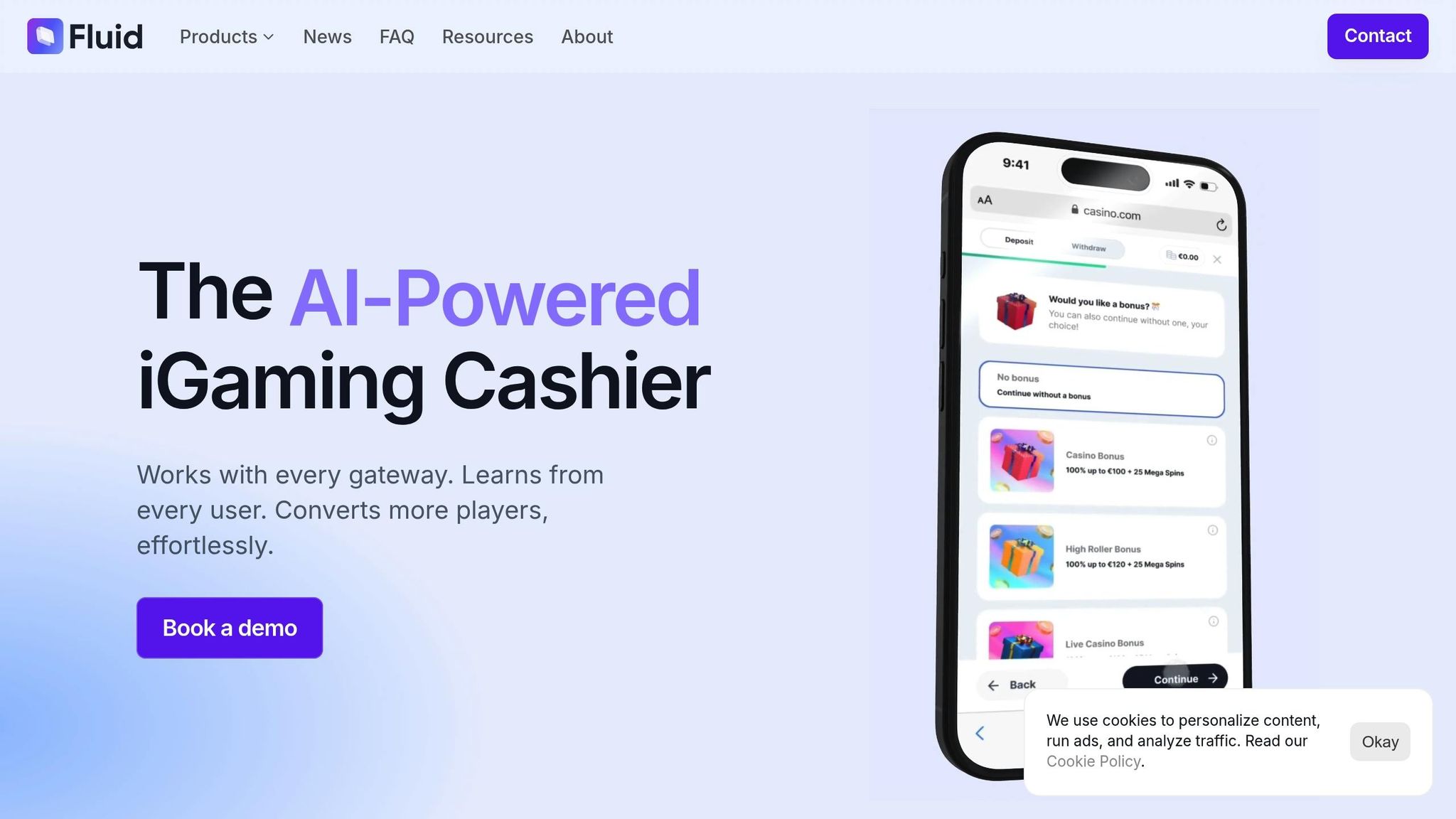
Fluid simplifies the integration process while offering a high level of customisation. Its API-first design allows for quick setup with less development effort compared to traditional payment systems.
Begin by customising the payment interface to align with your brand. Fluid makes it easy to incorporate your colours, fonts, logos, and messaging, creating a seamless experience that builds player trust.
One standout feature is Fluid's AI-driven payment journeys, which adapt to player behaviour in real-time. For example, returning players might see their preferred payment methods prioritised, while players from specific regions are shown locally popular options. Although this process is automatic, you can adjust the logic to meet your business goals.
Set fraud prevention parameters to balance security and user experience. Fluid's AI learns from transaction patterns, but you'll need to establish initial thresholds to flag suspicious activity. Overly strict settings can frustrate players, while lenient ones might expose you to fraud risks.
Use Fluid's analytics tools to track performance and manage multi-currency support. The platform provides insights into payment success rates, player behaviour, and method performance. Customise dashboards to focus on metrics that matter most to your business, such as regional trends or currency-specific data.
Decide how to display pricing to players - whether in their local currency or your base currency - and configure exchange rate updates. These decisions impact both player satisfaction and your financial processes.
Although Fluid's mobile-first design is user-friendly, test the system thoroughly on various devices. Ensure buttons are easy to tap, forms are simple to fill out, and the overall experience is smooth across different screen sizes and operating systems.
Once everything is in place, use real-time analytics to refine and improve your setup continuously.
Continuous Improvement Through Data Analysis
Treat payment optimisation as an ongoing effort. Regularly analysing data helps you adapt to changing player preferences, market trends, and regulatory updates.
Monitor conversion rates throughout the payment process. If players are dropping off at specific steps, investigate why. Maybe a form field is confusing, a payment method isn't loading, or the process is too slow. Addressing these issues can significantly boost revenue.
Evaluate payment method performance across different player groups. Some demographics may favour certain payment options, while others might see higher success rates at specific times. Use these insights to adjust the order and availability of payment methods.
Track transaction success rates and identify patterns in failed payments. Are certain cards being declined more often? Is a specific provider experiencing issues? Spotting these trends helps you address systemic problems and improve overall reliability.
Review fraud detection systems regularly to maintain the right balance. High false positive rates can frustrate legitimate players, while weak fraud controls leave you vulnerable to losses and penalties. Analyse flagged transactions to refine your settings.
Stay ahead of regulatory changes. In Malta and the EU, payment regulations like PSD2 are constantly evolving. Keep your system updated to meet new requirements, whether it's stronger authentication, enhanced monitoring, or updated reporting.
Schedule performance reviews with your payment provider to discuss metrics like transaction volumes, success rates, and technical issues. These meetings often uncover ways to improve your system and take advantage of new features.
When new features or payment methods become available, test them with small player groups before a full rollout. Measure their impact on conversion rates, transaction values, and player satisfaction.
Finally, benchmark against your own data rather than industry averages. Every casino has unique player demographics and market conditions. Focus on improving your own metrics over time, such as conversion rates, transaction success, and processing speeds.
Gather direct player feedback through surveys or support channels. Sometimes, players highlight issues that analytics can't reveal. If you notice recurring complaints, prioritise fixing them.
The iGaming payment landscape is always evolving. By treating optimisation as an ongoing process, you can stay competitive in Malta's dynamic market.
Conclusion
Choosing the right payment provider is more than just a technical decision - it's a strategic move that can shape your success in Malta's competitive iGaming market. Your payment system plays a crucial role in building player trust, increasing conversions, and ensuring long-term retention.
To get it right, your payment strategy should align with your business goals from the outset. For instance, if you're targeting specific regions, go for providers that support local payment methods and currencies. If you're catering to high-value players, focus on speed and premium payment options. And if security and compliance are your main priorities, opt for solutions with strong fraud prevention measures and tools that meet MGA reporting requirements. Every choice you make should support your broader business objectives.
Streamlining operations and enhancing player experiences is key, and this is where advanced tools come into play. For example, Fluid's AI-powered digital cashier can automate repetitive tasks, personalise payment options in real time, and provide data-driven insights to tackle potential revenue issues before they arise.
Security and compliance are non-negotiable. Malta's regulations demand robust transaction tracking, strong authentication, and continuous monitoring. Your system needs to strike the right balance between protecting sensitive data and offering a smooth, hassle-free experience for players.
Don't overlook the importance of testing your payment flows across different devices. With the majority of players now using smartphones and tablets, optimising for mobile experiences is essential. Regularly refining these processes based on real user behaviour can make a significant difference.
Finally, staying ahead in the fast-changing iGaming payment landscape means partnering with a provider who evolves alongside you. Look for transparency, actionable analytics, and a commitment to both compliance and player satisfaction. By aligning cutting-edge payment solutions with your strategic goals, you position your business for sustained success in Malta's thriving iGaming scene.
FAQs
What compliance standards must iGaming payment providers meet in Malta?
In Malta, iGaming payment providers are held to rigorous compliance standards to operate within the law and maintain responsible practices. This involves securing the appropriate licences from the Malta Gaming Authority (MGA), applying stringent Know Your Customer (KYC) and Anti-Money Laundering (AML) protocols, and ensuring that payment systems are secure to safeguard player information.
Beyond these measures, providers are also required to promote responsible gaming, maintain operational transparency, and follow EU regulations. Adhering to these standards not only keeps them compliant but also strengthens trust with players and industry partners.
How can AI tools improve payment experiences for online casino players?
AI tools have the potential to transform the payment experience for online casino players, making transactions faster, safer, and more personalised. With AI-powered fraud detection, casinos can monitor and block suspicious activities in real time, creating a more secure environment for both players and operators.
On top of that, AI simplifies payment processes by predicting player preferences, speeding up checkouts, and handling multi-currency transactions effortlessly. This is particularly useful for players in Malta, where the euro (€) is the standard currency. By incorporating AI, casinos can deliver a smoother, more efficient payment experience that aligns with the needs of their players.
What should you look for in a payment provider to support a global casino audience?
When choosing a payment provider for a global casino audience, it's crucial to focus on features that meet the needs of international players. Look for a provider that supports multiple currencies, including the euro (€), and offers payment options that are widely used in your target regions. Ensuring fast and secure transactions for both deposits and withdrawals can significantly improve the player experience.
It's also important to evaluate the provider's geographical coverage and their ability to handle large transaction volumes without disruptions. Advanced fraud prevention tools and AI-powered systems can help safeguard your platform while streamlining operations. Make sure the provider offers scalability and adaptability to meet the specific demands of your casino business.