
The Link Between Affiliate Traffic Quality and Payment Conversion
Nov 22, 2025
Fluid
Understanding the quality of affiliate traffic is crucial for improving payment conversions in iGaming, leading to better player engagement and retention.

Not all affiliate traffic is equal. In iGaming, focusing on traffic quality over sheer volume is essential for higher payment conversions. High-quality traffic attracts users more likely to deposit, engage, and provide long-term value, while low-quality traffic often results in wasted budgets and poor returns.
Key takeaways:
Quality traffic leads to better conversions, lower acquisition costs, and higher lifetime value.
Metrics like bounce rate, session duration, and click-to-deposit ratio help evaluate traffic quality.
Tools such as real-time analytics, fraud detection, and behavioural segmentation can identify and improve traffic sources.
Performance-based incentives (e.g., CPA or hybrid models) encourage affiliates to deliver better traffic.
Optimising payment experiences tailored to traffic sources reduces drop-offs and boosts conversions.
CRO in Affiliate Marketing: The Art of Converting Traffic into Sales
How to Identify High-Quality Affiliate Traffic
Spotting high-quality affiliate traffic boils down to understanding user behaviour and gauging conversion potential. These indicators help separate the profitable partnerships from those that drain your budget. The key is to focus on the right metrics and interpret them effectively.
Here’s a closer look at the metrics and tools that can help you assess traffic quality.
Metrics That Show Traffic Quality
Certain metrics paint a clear picture of traffic quality:
Bounce Rate: A low bounce rate suggests visitors are finding what they’re looking for. If users leave quickly, it likely means the affiliate’s messaging doesn’t align with your site’s offerings.
Session Duration: Longer sessions typically indicate that users are genuinely engaging with your content, especially when they come from targeted affiliates.
Click-to-Deposit Ratio: A high ratio means visitors are motivated and aligned with your goals. A low ratio, on the other hand, points to a mismatch between the audience and your product.
Average Player Value (APV): Analysing APV within the first few days of signup can reveal the value of the traffic. Higher APVs often correlate with users who deposit more and engage more consistently.
Geographic Consistency: Quality traffic aligns with the affiliate’s stated target regions. IP addresses should match the claimed demographics. If they don’t, it could signal bot activity or questionable practices.
Device and Browser Diversity: Authentic traffic comes from a variety of devices and browsers, reflecting natural user behaviour. A lack of diversity could be a red flag.
These metrics not only highlight traffic quality but also help predict user behaviour, including deposit likelihood and conversion success.
Compliance and Relevance Requirements
Traffic quality isn’t just about performance metrics - it’s also about compliance and relevance:
Regulatory Compliance: Affiliates must adhere to MGA guidelines, ensuring responsible gambling standards like age verification and clear messaging about problem gambling resources are in place.
Relevance: Affiliates need to understand their audience and tailor their efforts to match specific gaming products. For instance, an affiliate focusing on sports betting should drive traffic interested in that niche, rather than casino players.
Language and Localisation: Affiliates targeting English-speaking residents in Malta should ensure their content, payment options, and conversion paths meet local preferences, including using the correct currency formats.
Seasonal Trends: Authentic traffic often reflects natural fluctuations, such as holidays or major sporting events. Steady, unchanging traffic volumes might indicate less reliable sources.
Transparency: Credible affiliates disclose their traffic sources, marketing methods, and audience acquisition strategies.
Tools for Measuring Traffic Quality
The right tools can make all the difference when evaluating affiliate traffic:
Real-Time Analytics: Platforms like Fluid’s traffic insights dashboard track user behaviour from the first click to deposit, offering immediate quality indicators.
Behavioural Segmentation: These tools group traffic based on engagement patterns, highlighting high-value segments and flagging questionable sources.
Heat Mapping: By visualising user interaction on your site, heat maps can reveal whether traffic follows logical navigation paths or displays erratic behaviour.
Attribution Tracking: Multi-touchpoint tracking helps identify which affiliates contribute to conversions, even if deposits happen later.
Fraud Detection Algorithms: These tools spot bot activity and artificial traffic by analysing timing, technical patterns, and behavioural anomalies.
Conversion Funnel Analysis: Monitoring the user journey from click to deposit can reveal where lower-quality traffic drops off.
Custom Dashboards: Consolidating data into a single dashboard allows for real-time traffic quality scoring, providing a comprehensive view of affiliate performance.
How to Improve Affiliate Partnerships for Better Payment Conversions
Turning quality traffic into revenue hinges on building partnerships that are both well-planned and fully compliant. To create affiliate relationships that consistently deliver high-converting traffic, focus on strategic selection, performance-based incentives, and leveraging technology to optimise results.
How to Choose the Right Affiliates
Once you've identified quality traffic using key metrics, the next step is selecting affiliates who can sustain high payment conversions. The best partnerships come from working with affiliates whose goals align with your brand values and conversion objectives. Affiliates with a solid track record of attracting and engaging quality players are often a safe bet.
In Malta's regulated market, compliance is non-negotiable. Always request compliance documentation and thoroughly review promotional materials to ensure they meet regulatory standards.
To ensure brand alignment, it's essential to understand your audience. Affiliates should tailor their messaging to your target demographic. For instance, affiliates promoting luxury casino experiences should attract high-stakes players, while those focusing on sports betting should engage audiences interested in major sporting events or seasonal trends.
Clear communication is another cornerstone of a strong partnership. Affiliates who actively seek insights into your audience's preferences, payment methods, and seasonal behaviours are more likely to deliver results. Additionally, selecting affiliates with a deep understanding of local markets ensures their traffic aligns with natural user behaviour and payment patterns relevant to your goals.
Matching Affiliate Rewards with Conversion Goals
Traditional flat-rate commissions often fail to incentivise affiliates to deliver high-quality traffic. Instead, models like Cost Per Acquisition (CPA) can encourage a focus on players who make deposits. By tailoring CPA incentives to reward affiliates for bringing in quality leads, you can better align their efforts with your conversion goals.
Revenue-sharing models are another effective way to align affiliate interests with long-term player value. Offering more favourable terms during the initial stages of player engagement, followed by standard terms for ongoing activity, keeps affiliates motivated to deliver sustained results.
Hybrid models, combining CPA with revenue sharing, offer the best of both worlds by providing immediate rewards and long-term incentives. Performance bonuses tied to specific conversion metrics can further motivate affiliates to exceed targets, while tiered commission structures offer clear rewards for consistent, high-quality performance. Technology plays a key role here, offering real-time insights into affiliate performance to fine-tune these incentive models.
Using Fluid's AI Tools to Improve Partnerships
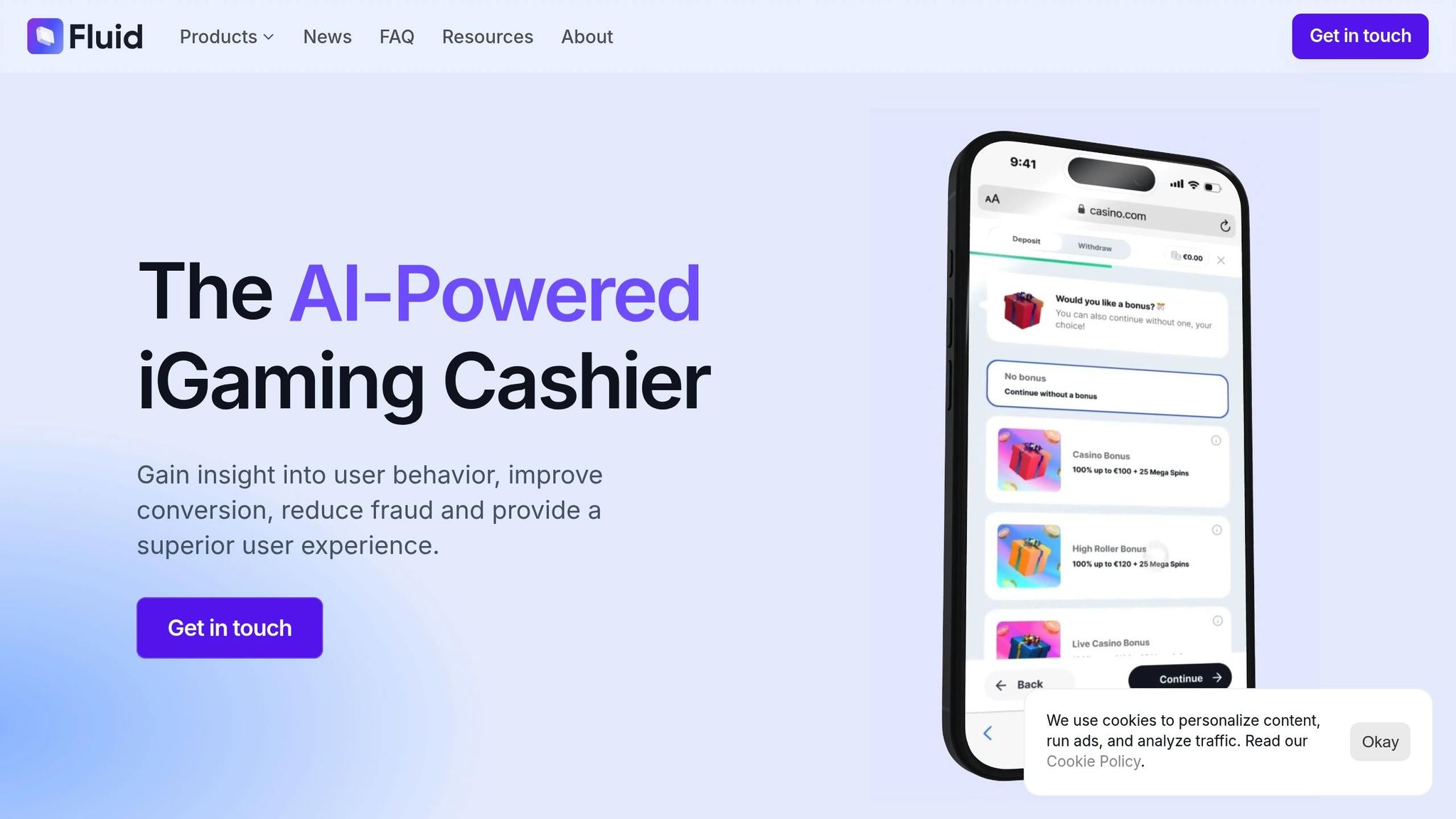
Advanced analytics and strategic partner management can take affiliate relationships to the next level. Fluid's AI-powered tools provide real-time insights into the quality of traffic and its conversion potential. By analysing affiliate sources, Fluid identifies those most likely to generate depositing players, enabling you to optimise commission structures and marketing efforts.
Fluid also enhances the payment experience through personalised journeys. Its AI analyses user behaviour from specific affiliates and adapts the deposit process to ensure a seamless and engaging experience. By tracking the user journey from the first click to deposit completion, Fluid pinpoints where potential customers drop off, offering actionable insights to improve both payment flows and affiliate messaging.
Fraud detection is another critical feature. Fluid's algorithms monitor for suspicious activities like bot traffic or artificially generated clicks, flagging low-quality sources before they impact your conversion rates.
Automated reporting simplifies affiliate management by delivering detailed performance insights without manual effort. These reports cover metrics such as conversion rates by traffic source, average deposit values, and preferred payment methods, allowing you to make data-driven adjustments to commission models and partnership strategies.
Lastly, Fluid's seamless integration ensures consistent branding and optimised user experiences across all affiliate traffic. This consistency builds trust and improves conversion rates. With a mobile-first design, even traffic from smartphones and tablets encounters user-friendly payment processes tailored for smaller screens and touch navigation.
Using Analytics to Boost Payment Conversion Rates
Analytics turn raw traffic data into clear, actionable insights. By analysing player behaviour from the moment they click to the point they deposit, you can pinpoint exactly where improvements are needed. Real-time data, in particular, highlights trends as they happen and allows for immediate adjustments. This instant feedback sets the foundation for a more in-depth analysis of your payment funnel.
How Real-Time Data Improves Payment Conversions
Real-time analytics give you an up-to-the-minute view of how your payment processes are performing. This allows you to detect and address problems before they escalate into costly issues. For instance, you can see how different traffic sources are performing and quickly tweak commission structures or adjust partnerships that aren’t delivering results.
Payment preferences often vary depending on the traffic source or even the time of day. Real-time insights can reveal patterns, like when players from specific affiliates favour credit cards over e-wallets or when cryptocurrency deposits surge during certain hours. With this knowledge, you can dynamically adjust payment options to show the most relevant methods first, tailored to current traffic trends.
Geographic and device-specific insights also play a big role in optimising the payment experience. For example, if mobile users in a particular region are abandoning the process at a higher rate, you can address this by simplifying mobile payment forms or offering localised options that better suit their needs.
One of the greatest advantages of real-time analytics is speed. You can test changes and see results in hours rather than waiting for weekly reports. This quick feedback loop allows you to make continuous improvements and address small issues before they grow into major conversion problems.
Finding and Fixing Payment Funnel Problems
A detailed payment funnel analysis can reveal exactly where potential customers are dropping out of the deposit process. By identifying these bottlenecks, you can implement specific solutions to recover those lost conversions.
Drop-off analysis helps pinpoint where users are abandoning the payment flow. Common culprits include overly complicated payment pages, lengthy forms, or confusing error messages. Streamlining these areas and providing clear guidance at each step can significantly improve the user journey.
Error tracking is another critical tool. Failed payment attempts often stem from issues like expired cards, insufficient funds, or payment processor timeouts. Advanced analytics can categorise these failures, helping you spot patterns such as affiliates with higher card declines or times when certain payment processors are more likely to experience timeouts.
Behaviour tracking also sheds light on user experience friction points. If players are spending too much time on a specific page, repeatedly clicking submit, or navigating back and forth between steps, it’s a clear sign of confusion or technical problems that need immediate attention.
Mobile users often face unique challenges, which require tailored solutions. A mobile-first design approach ensures that payment processes run smoothly across all devices, helping to reduce drop-offs from this increasingly important segment of users.
By monitoring key metrics like conversion rates, time spent on pages, and completion rates by traffic source, you can prioritise improvements where they’ll have the most impact. This data also helps identify affiliate partnerships that could benefit from better payment flow optimisation.
Case Study: Improving Payment Conversions with Analytics
The power of analytics becomes even clearer when applied to real-world scenarios. In the following case study, we’ll explore how systematic use of payment analytics led to measurable improvements in conversion rates.
Identifying the core issue often starts with a deep dive into traffic data from all affiliate sources. Analytics frequently reveal that some affiliates drive traffic with low deposit completion rates, even if their click-through metrics seem strong. This mismatch might point to either poor traffic quality or a payment experience that doesn’t align with the needs of certain user segments.
Implementing data-driven solutions involves addressing these issues through multiple layers of improvement. Adjusting payment method options based on affiliate traffic preferences, simplifying forms for mobile users, and creating personalised user journeys all contribute to higher conversion rates. AI-powered tools can adapt the payment experience in real time, tailoring it to user behaviour and traffic characteristics.
Measuring the results is crucial to prove the effectiveness of these changes. Successful strategies typically lead to lower payment abandonment rates, higher average deposit values, and stronger affiliate performance. The combined effect of better traffic analysis and improved payment flows often leads to long-term benefits that go beyond individual conversions.
Continuous improvement is key to maintaining these gains. As traffic patterns evolve and new affiliate partnerships emerge, regular analysis ensures your payment processes stay optimised. Ongoing monitoring not only preserves high conversion rates but also helps uncover new opportunities for improvement.
Ultimately, the most effective analytics strategies focus on meaningful insights rather than vanity metrics. By improving conversion rates, cutting payment processing costs, and enhancing affiliate partnerships, analytics deliver measurable business value that justifies their continued use and development.
Key Points and Next Steps
The connection between affiliate traffic quality and payment conversion rates isn’t just a theory - it’s a measurable factor that directly affects your revenue. Focusing on high-quality affiliate traffic can lead to significant improvements in your bottom line, outperforming strategies that prioritise volume over substance.
Business Benefits of Quality Affiliate Traffic
High-quality affiliate traffic has a ripple effect across your business. Affiliates who align well with your platform attract players who are ready to deposit, resulting in better conversion rates and stronger player retention.
When the quality of traffic improves, payment conversion rates follow suit. Players arrive with a clear understanding of your platform, leading to more completed deposits, fewer abandoned transactions, and reduced strain on customer support teams.
The financial advantages go beyond individual transactions. Quality traffic helps lower chargebacks and disputes since players come with realistic expectations about your services. It also reduces fraud, as reputable affiliates tend to use stricter traffic screening processes compared to those focused purely on volume.
Your brand reputation also benefits from prioritising quality. Platforms that consistently attract engaged, satisfied players naturally see an increase in word-of-mouth referrals. This type of organic growth complements affiliate efforts, creating a positive cycle of acquiring quality traffic.
To fully leverage these benefits, adopting actionable strategies is key to strengthening your affiliate partnerships.
Action Steps for iGaming Operators
Here’s how you can take advantage of the benefits of quality affiliate traffic:
Audit your current affiliate partnerships: Go beyond metrics like click volumes or sign-ups. Focus on conversion rates, player retention, and deposit completions. Identify affiliates who consistently deliver high-performing traffic and those who may be underperforming.
Use advanced tracking and regular performance reviews: Monitor the entire player journey, from the affiliate click to deposit completion. Tools like Fluid’s AI-powered analytics provide real-time insights, helping you make informed decisions about affiliate partnerships and payment processes. This level of detail allows you to spot issues early and adjust strategies as needed.
Revise commission models to prioritise quality traffic: Introduce tiered commission structures that reward affiliates for delivering traffic that converts well. This approach encourages affiliates to focus on quality over quantity.
Schedule regular assessments: Conduct monthly or quarterly reviews to evaluate not just traffic volumes but also conversion quality, player behaviour, and long-term value. Use these sessions to provide affiliates with feedback and identify ways to improve together.
Optimise the payment experience: Leverage traffic insights to refine the payment process. Fluid’s personalised payment journeys can adapt to specific traffic sources, offering the most relevant payment methods and simplifying deposits based on user behaviour and affiliate characteristics.
FAQs
How can iGaming operators in Malta ensure their affiliate traffic meets regulatory standards?
iGaming operators in Malta can stay on the right side of regulatory standards by following the Malta Gaming Authority (MGA) guidelines to the letter. This means fulfilling all reporting duties related to financial, technical, and operational matters, while ensuring transparency in every aspect of their affiliate marketing efforts.
A strong focus on responsible gambling is crucial. Operators must safeguard players, prioritise secure systems, and implement robust measures to protect user data. Regular audits and compliance reviews are key steps to meet both local and EU regulations. Maintaining open communication with affiliates and consistently monitoring the quality of traffic helps operators stay compliant and preserve the credibility of their operations.
What are the best ways to identify and prevent low-quality or fraudulent affiliate traffic?
Detecting and stopping low-quality or fraudulent affiliate traffic is essential for keeping your payment conversion rates strong. Modern AI-powered tools can play a key role in this process by tracking traffic sources, analysing user behaviour, and monitoring payment trends to spot suspicious activities. These tools rely on real-time analytics and machine learning to identify red flags like fake clicks, sudden traffic surges, or bot-driven activity.
To maintain high-quality affiliate traffic, it’s worth exploring platforms that offer customisable rules, real-time alerts, and comprehensive dashboards for fraud detection. These features allow you to block harmful IP addresses, filter out fake clicks, and fine-tune your affiliate partnerships. By taking advantage of these technologies, you can ensure your traffic sources drive better payment outcomes and deliver a stronger return on investment (ROI).
How can affiliates be incentivised to drive high-quality traffic in the iGaming industry?
To inspire affiliates to bring in top-notch traffic, offering performance-based incentives can make a big difference. Options like revenue share models, performance bonuses, and gamified rewards can be aligned with clear goals for traffic and conversions. These approaches not only motivate affiliates but also help build lasting partnerships.
Leveraging real-time analytics and automated tracking tools adds transparency and pinpoints the best-performing affiliates. By establishing clear benchmarks and rewarding consistent, high-quality traffic, businesses in Malta can strengthen affiliate relationships and improve payment conversion rates. Customising agreements to fit the local market adds another layer of effectiveness to these partnerships.