
How Fluid Future-Proofs Operators by Supporting Any PSP, Gateway, or Payment Route
Jan 20, 2026
Fluid
One integration to connect any PSP, gateway or route; AI routing, automated compliance, fraud detection and crypto support for resilient iGaming payments.

In iGaming, payment flexibility is critical. Operators in Malta face challenges like managing multiple payment providers, ensuring compliance with strict regulations, and meeting player expectations for fast, seamless transactions. Fluid simplifies this by offering a single integration that connects to multiple payment service providers (PSPs), gateways, and payment routes.
Here’s what Fluid does:
Single Integration: Connects operators to all PSPs, reducing the need for multiple API setups.
Smart Routing: Uses AI to optimise transactions based on cost, approval rates, and speed.
Compliance Automation: Ensures real-time adherence to Malta Gaming Authority (MGA) and Financial Intelligence Analysis Unit (FIAU) standards.
Fraud Detection: Monitors and prevents suspicious activities with advanced AI tools.
Crypto-Friendly: Supports emerging payment methods like cryptocurrencies with low fees and instant settlements.
Fluid helps operators maintain uninterrupted payment processing, reduce costs, and improve player satisfaction in a fast-evolving market. With its PSP-agnostic platform, businesses can easily adapt to new payment trends and regulatory changes while maintaining operational stability.
High-Risk Payment Processing in 2025 (Online Casinos, Sports Book, Lotto)
Payment Challenges Facing iGaming Operators
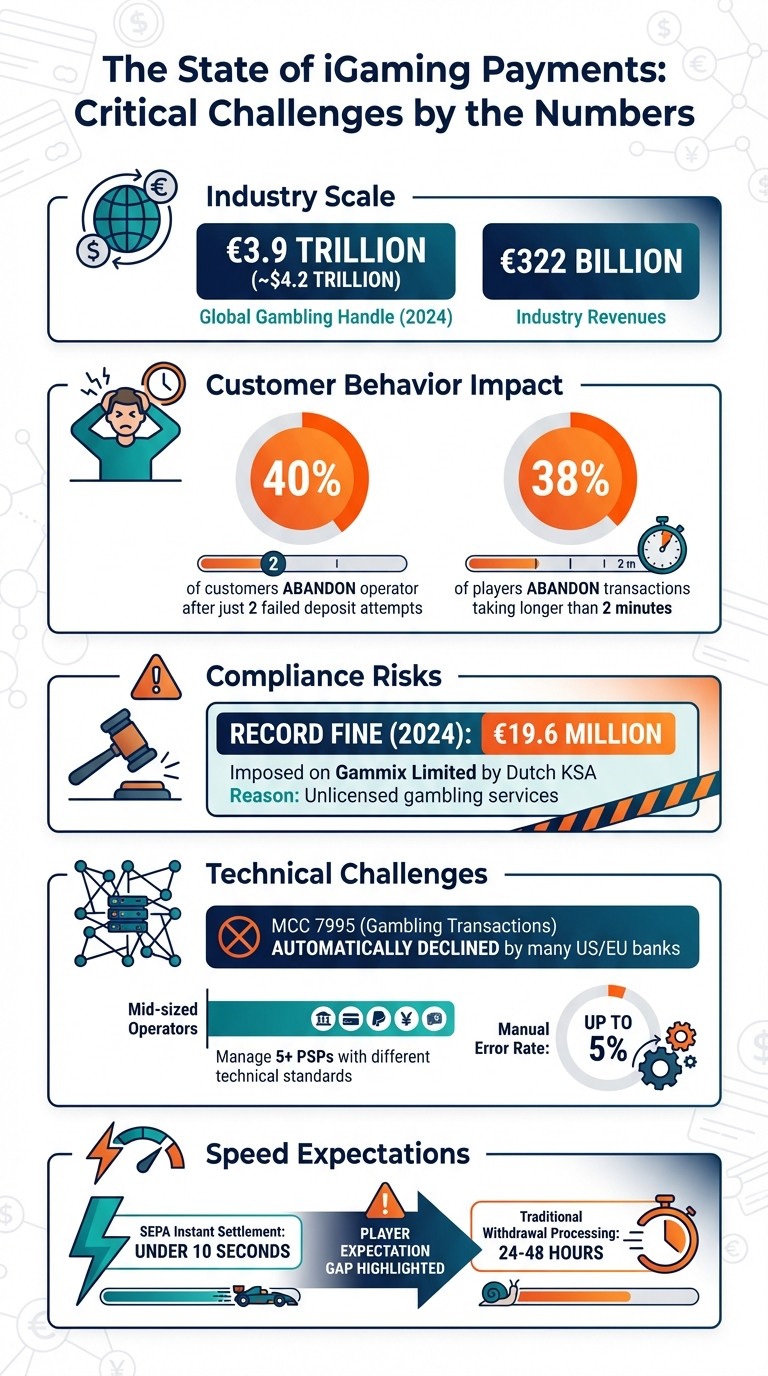
iGaming Payment Challenges: Key Statistics and Industry Impact
Operating an iGaming business in Malta comes with its fair share of payment hurdles - many of which are unique to the industry. Traditional banks often label iGaming as "high-risk", which can result in sudden account closures or frozen funds without prior notice. To avoid disruptions in revenue flow, operators have to rely on multiple payment service providers (PSPs). This necessity brings its own set of operational and compliance challenges, as outlined below.
Dealing with multiple PSPs creates what’s known as integration debt. Each PSP requires a separate API integration and manual reconciliation process, which drains resources that could be better spent on core business activities. For a mid-sized operator catering to players across Europe, this could mean managing connections with five or more PSPs, each with its own technical standards, reporting formats, and settlement timelines.
Managing Multiple PSPs and Payment Routes
The use of MCC 7995, the merchant category code for gambling transactions, often complicates things further. Many banks in the US and EU automatically decline transactions flagged with this code, even when the operator is fully licensed. This can lead to legitimate deposits being rejected, forcing operators to reroute payments through alternative channels.
To put the scale of the industry into perspective, the global gambling handle is expected to reach approximately €3.9 trillion (around $4.2 trillion) in 2024, generating about €322 billion in revenues. Yet, despite this impressive growth, up to 40% of customers abandon an operator after just two failed deposit attempts. For operators working across borders, additional challenges include fluctuating exchange rates, conversion fees, and the need to accommodate local payment methods like PIX in Brazil or UPI in India.
Meeting Regulatory and Compliance Requirements
Payment processes for iGaming operators are further complicated by regulatory demands. Malta’s regulatory framework, for instance, enforces strict AML (anti-money laundering) and KYC (know your customer) protocols. However, these requirements differ significantly from one jurisdiction to another. For example, while the UK Gambling Commission prohibits credit card deposits, Malta Gaming Authority (MGA) regulations focus on measures like player fund segregation and verifying sources of funds. Operators serving multiple regions must adapt their compliance checks to meet the specific rules of each market.
The risks of non-compliance are stark. In 2024, the Dutch gambling authority (KSA) imposed a record-breaking fine of €19.6 million on Malta-based Gammix Limited for offering unlicensed gambling services in the Netherlands. Meanwhile, the EU’s MiCA framework is bringing new standards for handling digital assets, requiring operators to implement real-time compliance measures for cryptocurrency transactions. For operators offering crypto payments, this often involves retrofitting existing systems to include new compliance layers.
What Players Expect from Payment Systems
Today’s players have little patience for payment delays. Research shows that 38% of players abandon transactions that take longer than two minutes. They expect deposits to be instant, allowing them to start playing immediately, and withdrawals to be processed within hours - not days. When these expectations aren’t met, players are quick to switch to competitors who offer faster and more efficient services.
Transparency is just as important. Players want to know exactly how much they’re depositing, with fees and conversion rates clearly displayed. For example, a deposit screen showing "€50.00" inspires far more trust than one with vague disclaimers about additional charges. It’s also essential for payment interfaces to consistently use Malta’s standard currency format, which includes a space after the Euro symbol (e.g., €1,000.00) and a period for decimals.
The introduction of SEPA Instant in Europe has raised the bar for payment speed. With settlement times now achievable in under 10 seconds, players increasingly question why withdrawals still take 24–48 hours to process. Operators relying on outdated systems that batch process transactions risk falling behind competitors offering near-instant payouts. Beyond withdrawals, players now expect real-time balance updates, instant deposit confirmations, and immediate access to their funds across all payment methods. These demands highlight the growing need for a streamlined and integrated payment orchestration system.
How Fluid Simplifies Payment Integration
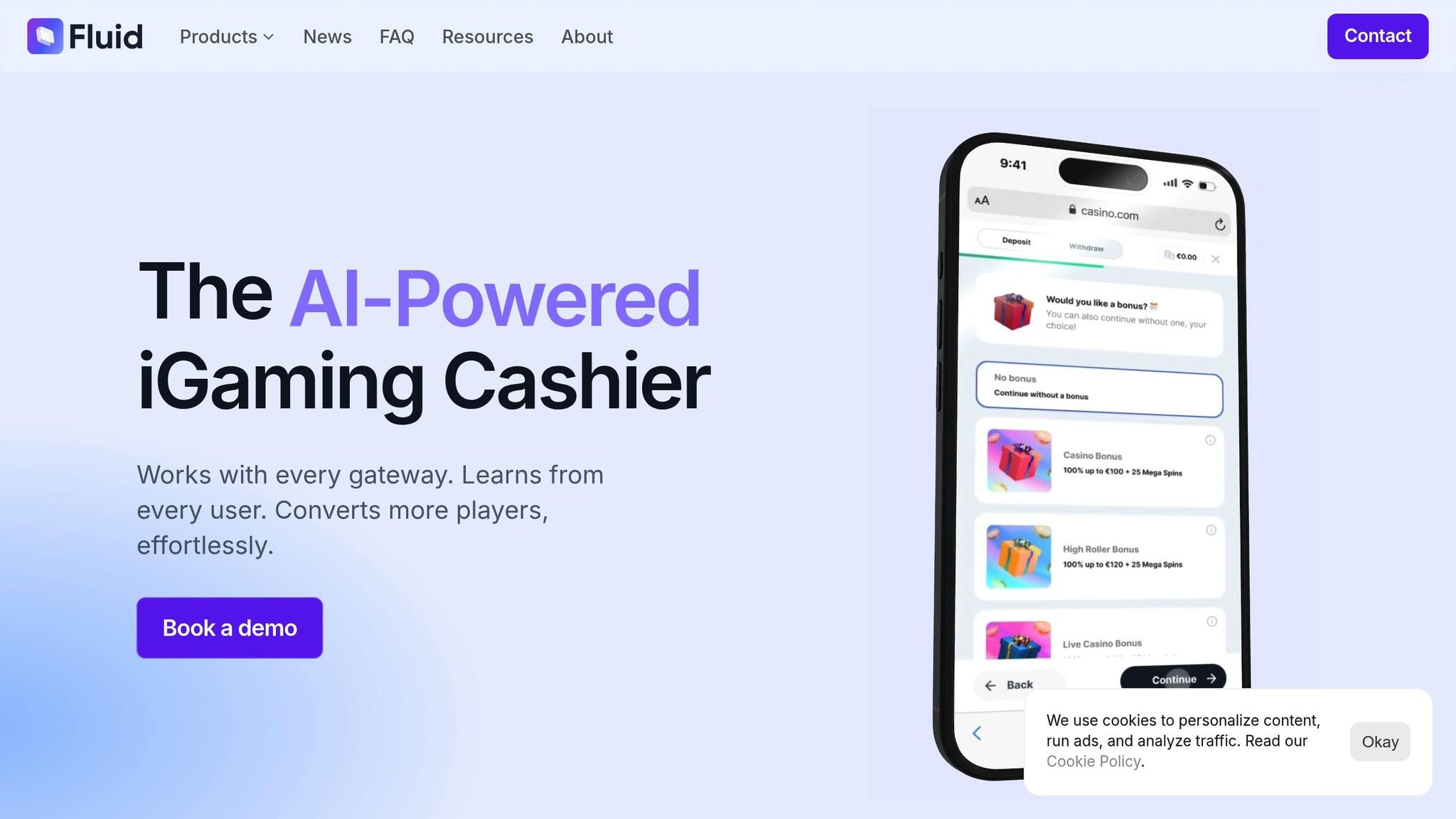
Managing multiple payment service providers (PSPs) doesn’t have to be a logistical nightmare. Fluid acts as a single orchestration layer between your checkout system and your PSPs, eliminating the need to build and maintain separate connections for each provider. Instead of grappling with the unique technical requirements of multiple PSPs, you integrate with Fluid just once and gain access to a variety of gateways and payment routes. This streamlined approach not only simplifies operations but also ensures your payment system is ready to adapt to changing market demands. The result? Smarter processing and stronger risk management.
One Integration for Multiple PSPs
Merchants often struggle with the complexity of integrating multiple PSPs. Fluid solves this problem with a PSP-agnostic setup that works with any gateway - no need to alter your core code. Integration is quick and straightforward: you can add just two lines of JavaScript for a fast setup or opt for Fluid’s RESTful API with webhooks for real-time transaction updates.
"Fluid connects seamlessly to any gateway. Run them all in parallel for better uptime, routing and user experience – without changing a single line of code."
This flexibility allows you to adapt as your business grows or changes. If a PSP alters its fee structure or closes your account, you don’t need to overhaul your payment infrastructure. Simply configure a new route through Fluid’s platform and keep your payments flowing without interruption.
And Fluid doesn’t stop at simplifying integrations - it also optimises your transactions with intelligent, data-driven routing.
AI-Powered Payment Routing
Fluid’s AI-powered routing engine takes payment processing to the next level. It evaluates transactions in real time, choosing the best route based on factors like cost, speed, success rates, and location. For instance, a deposit from a customer in Germany might be routed differently from one in Brazil, ensuring higher approval rates while keeping fees low.
The system leverages historical transaction data to predict which routes are most likely to succeed for specific types of payments. If a transaction fails, Fluid automatically retries it through alternative processors. This failover feature is a lifesaver during peak traffic or when a PSP experiences technical issues, helping you recover revenue that might otherwise be lost.
This smart routing pairs seamlessly with advanced fraud detection, ensuring your transactions remain secure.
Fraud Detection and Risk Management
For iGaming operators, fraud is a constant concern - whether it’s chargebacks, account takeovers, or other malicious activities. Fluid’s AI and machine learning capabilities actively monitor transaction patterns, flagging suspicious behaviour before it can harm your business.
Because Fluid processes transactions across multiple operators, its fraud detection models benefit from a vast dataset that no single operator could gather on its own. This allows the system to spot emerging fraud trends, such as card testing or bonus abuse, and implement protective measures across all connected operators. Additionally, Fluid ensures PCI-DSS compliance and automates MGA reporting, easing the workload for your compliance team while keeping you aligned with regulatory standards.
How Fluid's PSP-Agnostic Architecture Protects Your Business
The iGaming industry is in a constant state of flux. Payment Service Providers (PSPs) adjust their fee structures, regulators introduce new rules, and banks reassess their risk profiles. If your payment system is tied to a single provider or requires custom development for every gateway, these shifts can cause major disruptions. Fluid's PSP-agnostic architecture steps in to solve this issue by creating a flexible layer between your checkout process and PSPs, ensuring seamless adaptability.
Modular Design for Flexible PSP Management
Fluid's modular "plug and play" design eliminates the risk of being locked into a single provider. With just one integration, the platform connects to any gateway or orchestration layer, enabling you to add, remove, or replace PSPs without touching your core code. This flexibility isn’t just about managing crises. As you expand into new markets, you can quickly integrate regional PSPs that offer better local payment options or more favourable terms - all without additional technical work. For large enterprises, managing over 20 PSP integrations through orchestration layers is common, ensuring global reach and operational stability.
Adapting to Evolving Regulatory Requirements
Regulatory compliance in iGaming is always changing. Authorities like the Malta Gaming Authority (MGA) and EU regulatory bodies frequently update standards for payment reporting, anti-money laundering, and licensing. Fluid’s multi-gateway redundancy ensures that if one PSP encounters regulatory issues or loses its licence, transactions are instantly rerouted through compliant alternatives. Additionally, Fluid’s automated audit trails and monitoring tools simplify compliance updates, reducing the need for manual intervention. This adaptability is key to staying ahead of regulatory risks.
Shielding Your Business from Market Disruptions
Bank de-risking - when financial institutions withdraw services from iGaming operators - continues to pose challenges. Fluid’s architecture addresses this by maintaining a diverse network of PSPs operating in parallel. If your primary payment processor fails, times out, or exits the market, transactions are seamlessly redirected to backup providers without any interruptions for players. This redundancy ensures your revenue stream remains intact and your players’ trust is safeguarded, even during unexpected market disruptions.
Business Benefits of Using Fluid
Fluid offers a range of advantages that directly impact your bottom line. Its AI-driven design reshapes how iGaming operators handle costs, player conversions, and compliance, all while keeping daily operations straightforward.
Lower Costs and Streamlined Operations
Fluid's automation significantly reduces manual workloads, saving both time and resources. By consolidating transaction validation, reconciliation, and compliance monitoring into one user-friendly interface, operators can manage multiple gateways simultaneously - without needing to alter code. This approach minimises the need for large oversight teams and virtually eliminates costly human errors. For context, manual processes can have error rates of up to 5%, but Fluid’s automation keeps errors close to zero.
The platform’s fast integration also cuts down setup times and operational expenses. Its AI-powered routing system directs transactions to the most cost-efficient processors while ensuring high success rates. During high-traffic events, such as major sporting championships, the system scales automatically, negating the need for extra staff to handle transaction surges. These efficiencies translate into direct operational savings.
Improved Conversion Rates and Player Retention
Reducing payment-related friction is key to boosting both conversion and retention rates, and Fluid excels in this area. Through smart prompts and nudges, the platform guides players seamlessly through bonus selections and deposit options, offering timely incentives and fast-track paths. Additionally, its in-game quick deposit feature allows players to top up their accounts without leaving the gaming interface, keeping them engaged and reducing drop-offs. For failed payments, Fluid’s intelligent routing system redirects transactions to backup gateways, recovering revenue that might otherwise be lost.
The platform also tailors payment experiences with localised, mobile-friendly flows, enhancing the user experience and reducing checkout abandonment. This personalised approach not only improves immediate conversions but also encourages players to return, positively influencing long-term retention. While higher conversion rates drive revenue growth, robust fraud prevention measures ensure that progress is sustainable.
Enhanced Fraud Prevention and Compliance
Fluid’s real-time AI and machine learning tools, including the AttackDog and WatchDog systems, detect and respond to fraudulent activity instantly. Unlike traditional rule-based systems that lag behind evolving threats, these tools adapt in real time. Automated KYC (Know Your Customer) and AML (Anti-Money Laundering) checks ensure quick verification, reducing the risk of regulatory penalties while maintaining player confidence.
Live dashboards and custom reporting features offer full visibility into transaction performance, helping operators identify issues like drop-offs and run A/B tests to refine payment flows. Compliance monitoring is fully automated, with built-in audit trails to simplify regulatory updates. This is particularly valuable for operators under the jurisdiction of the Malta Gaming Authority or navigating broader EU compliance standards. By automating these critical processes, Fluid not only safeguards revenue and reputation but also positions operators to stay ahead in an ever-changing market.
Supporting New Payment Methods and Trends
Payment Trends Changing the iGaming Industry
The iGaming world is experiencing a significant shift in how payments are made, driven by the need for speed and flexibility. Digital wallets like Apple Pay and Google Pay continue to lead mobile transactions, while cryptocurrencies and stablecoins - now valued at an impressive US$280 billion - are becoming popular for cross-border deposits. Players today expect instant payouts, making the traditional 3–5 day settlement periods feel outdated. These changes are pushing operators to rethink their payment strategies to remain competitive.
To stay ahead, Fluid has developed solutions that integrate both traditional and emerging payment methods effortlessly.
How Fluid Supports New Payment Methods
Fluid’s system makes adopting new payment options a breeze. Its plug-and-play framework allows operators to quickly implement cryptocurrencies, digital wallets, and other modern payment solutions. Thanks to its PSP-agnostic (Payment Service Provider-agnostic) design, operators can run multiple gateways side by side - whether using traditional card processors or crypto-focused options - without the hassle of rewriting code.
Fluid also uses AI-powered routing to ensure transactions are processed through the most efficient channels. For example, payments can be routed through a stablecoin gateway with fees as low as 0.5%, or through a conventional processor, depending on what works best. Automated KYC (Know Your Customer) processes make onboarding seamless for users of both digital wallets and cryptocurrencies. Plus, its built-in multi-currency capabilities ensure smooth operations across different markets.
Preparing for Future Player Preferences
Fluid’s modular platform ensures you’re not tied to today’s payment technologies. As player habits change and new payment methods emerge, the system evolves without requiring a complete overhaul of your payment infrastructure. A great example of this adaptability is Fluid’s October 2025 partnership with iConvert, which leverages real-time data to optimise the player’s journey from their first click to their final deposit.
Conclusion: Prepare Your iGaming Payments for the Future with Fluid
The iGaming industry thrives on staying ahead of shifting player expectations and market trends, and having a payment system that can keep up is non-negotiable. Fluid’s PSP-agnostic architecture makes this possible by letting you connect any gateway or orchestration platform seamlessly through a single integration. This adaptability has already benefited operators like VINN.com, which teamed up with Fluid in August 2025 to enhance their cashier experience across European markets.
By May 2025, Fluid had already processed 5 million transactions, showcasing its ability to handle high volumes under real-world conditions. With AI-driven routing and automated failover mechanisms, the platform ensures uninterrupted revenue flow, even during service disruptions, making your payment infrastructure more resilient to future challenges.
On top of its technical capabilities, Fluid’s modular design simplifies compliance. Built-in KYC and AML verification align with MGA and FIAU standards, while supporting a broad range of payment options - from traditional cards to digital wallets and cryptocurrencies - all through one integration.
Adding a payment orchestration layer like Fluid doesn’t just shield your business from market volatility; it also equips you to embrace emerging payment trends without overhauling your systems. The platform customises payment flows, combats fraud, and delivers real-time analytics to identify exactly where players may abandon transactions.
In short, Fluid’s architecture is built not just to meet today’s needs but to anticipate tomorrow’s possibilities. The real test lies in whether your infrastructure can evolve alongside payment technologies, regulations, and player behaviours. With Fluid, you’re ready for whatever comes next - without the headache of constant redevelopment.
FAQs
How does Fluid's AI-powered routing enhance payment success rates for operators?
Fluid’s AI-driven routing system takes payment processing to the next level by analysing player behaviour and transaction data in real-time. This allows it to pinpoint the most effective payment path for each transaction. And if a transaction fails? The system immediately retries with alternative processors, ensuring a seamless payment experience for players.
This smart system doesn’t just boost deposit success rates - it also helps minimise transaction abandonment. By fine-tuning payment routes, operators can see up to a 30% increase in overall transaction success rates. It’s a dependable and adaptable solution designed specifically for the unique demands of the iGaming industry.
How does Fluid's PSP-agnostic system benefit iGaming operators in Malta?
Fluid’s PSP-agnostic system makes it easy for iGaming operators to connect with any payment service provider, gateway, or route - without needing to overhaul their existing setup. By adding just a few lines of code, operators can quickly introduce new payment methods, saving both time and resources for other operational priorities.
This approach allows operators to provide a broad range of payment options, including cards, e-wallets, cryptocurrencies, and local Maltese banking solutions, all while adhering to Malta Gaming Authority (MGA) regulations. The system also features smart routing, which not only cuts costs but also ensures smoother transactions by automatically redirecting failed payments through alternative processors.
With its ability to keep up with changing player preferences and offer real-time analytics, Fluid enables operators to expand into new markets, improve payment efficiency, and deliver a seamless experience. This ultimately drives higher deposits and boosts player retention in Malta’s tightly regulated iGaming sector.
How does Fluid help operators stay compliant with Malta's gaming and payment regulations?
Fluid ensures adherence to Malta’s gaming and payment regulations by embedding real-time monitoring and AI-powered fraud detection into its platform. This includes automated enforcement of PCI-DSS, KYC/AML, and anti-money laundering protocols. The system also continuously verifies player identity, age, and deposit limits, ensuring alignment with the latest Malta Gaming Authority (MGA) rules and EU directives like GDPR and AMLD5.
The platform’s API-first architecture gives operators the ability to adjust swiftly to regulatory updates. Payment routing can be modified instantly to comply with new licensing, currency, or reporting standards - eliminating the need for code changes. On top of that, features like automated audits, tokenisation, and encryption ensure data protection and compliance with segregated fund requirements.
By blending cutting-edge compliance tools with a modular framework, Fluid enables operators to navigate Malta’s rapidly changing iGaming landscape while maintaining smooth and efficient operations.