
The cashier built for
the rhythm of sports.
Inline deposits on the bet slip. Smart retry when a card declines mid-game. Multi-PSP routing tuned per market. The cashier licensed sportsbook operators run when the deposit can’t be the slow part.
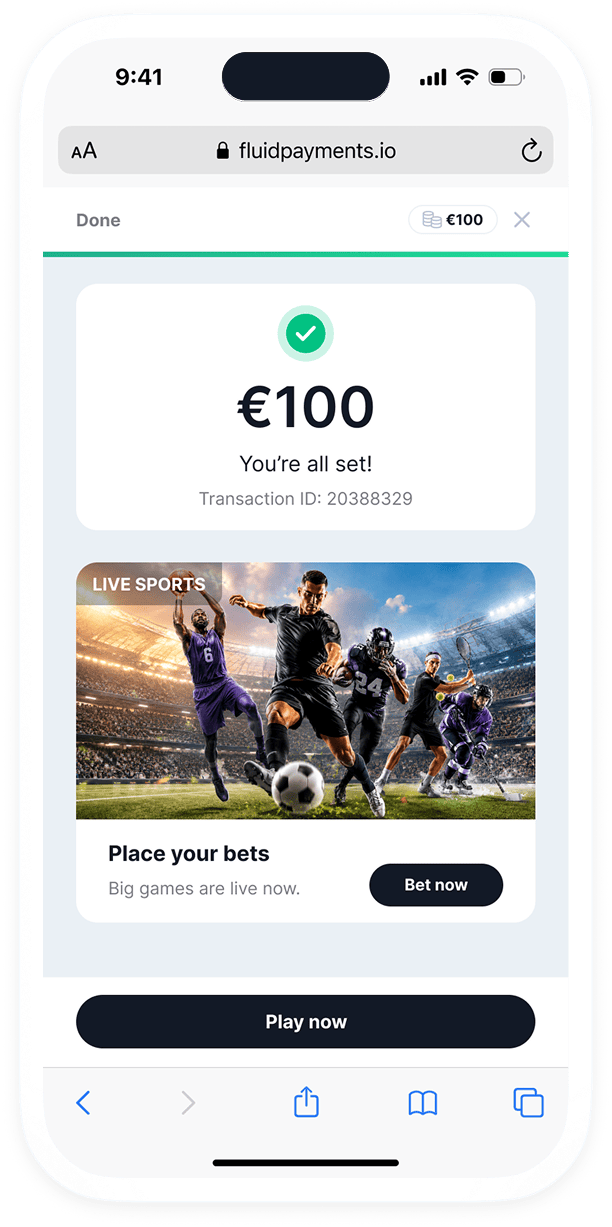
The deposit window is shorter in sportsbook than anywhere else.
The line is moving in real time, the player has the bet slip half-built, and they need to top up balance now — not in 30 seconds. Every extra step in the deposit funnel is a chance for the player to bail, lose the bet, and not come back this evening.
Most sportsbooks still bolt a hosted cashier from a legacy orchestrator onto the side of an otherwise modern frontend. That means an iframe round-trip on a third-party domain, a static method drop-down, and a generic decline experience when a card processor times out. None of that survives contact with a live in-play deposit.
Fluid is built for that window. The cashier renders inside your DOM, the flow tunes itself per player and per market, it works with whatever multi-PSP orchestration you already run, and the dashboard tells you what is happening while it is happening.
How Fluid solves it for iGaming operators.
Six things the cashier does that a legacy iframe simply can’t.
Deposits at the speed of in-play
When the line is moving, a player who can't deposit in 10 seconds is a player who walks. Fluid is built for that window: pre-saved methods, one-tap deposit confirmation, instant fail-over to a backup PSP if the primary times out. The cashier never breaks the tempo of the bet.
Quick-deposit on the bet slip
Fluid renders inline — players top up balance from the bet slip itself, without leaving for a separate cashier screen and losing their selections. One of the largest single conversion levers we see for sportsbooks.
Smart retry on declines
A card decline mid-bet is a classic conversion killer. Fluid distinguishes hard declines (fraud, lost-card flag) from soft declines (network flake, 3DS timeout) and routes the soft-decline traffic to a successful method automatically — typically without the player ever seeing the failure.
Multi-PSP routing per market
The wallet that wins in DACH is not the card processor that wins in LatAm. Fluid surfaces every PSP your orchestrator runs through a single cashier UI, ordering methods per player, per region, per time of day — optimising what the player picks first. The actual transaction routing still happens in your orchestration layer.
KYC inside the deposit
Sportsbook regulations push verification into the deposit funnel, especially around large or unusual amounts. Fluid handles in-flow KYC tiers and source-of-funds prompts so the player never bounces to a separate process when the bet is on the line.
Real-time visibility on spikes
When a marquee match drives 10x normal deposit volume, you need to see deposit-success rate in real time, not in tomorrow’s ETL job. Fluid Control surfaces method, PSP, and region breakdowns live so your team can react during the spike, not after it.
Customer story
PowerPlay’s sportsbook runs on Fluid.
PowerPlay is a licensed Canadian operator running sports betting alongside casino and live dealer products. The team chose Fluid’s context-aware cashier specifically to make deposits feel as fast as the rest of their sportsbook product — pre-saved methods surfaced first, regional payment routing, and AI-driven A/B testing on deposit flows so the team could keep optimizing without quarterly redesign cycles.
Dean Serrao, CEO of PowerPlay, framed it as a player-experience priority: a fast, localized payment journey was core to the product they wanted to ship. Read the full PowerPlay partnership announcement.
Live in days, not months.
Three steps from "we are evaluating" to "the lift is in the dashboard."
Connect
Two lines of JavaScript on your sportsbook frontend, every PSP you already run registered into Fluid Control. The cashier sits inside your DOM — no iframe redirect, no payment-flow hand-off.
Configure
Theme to match your sportsbook brand exactly. Set per-region routing rules, per-amount KYC tiers, retry policies, and risk thresholds — all from the dashboard, no engineering tickets.
Convert
Go live. The AI begins personalizing the cashier inside the first session of player traffic. You see deposit-success uplift in the dashboard within the first weeks.